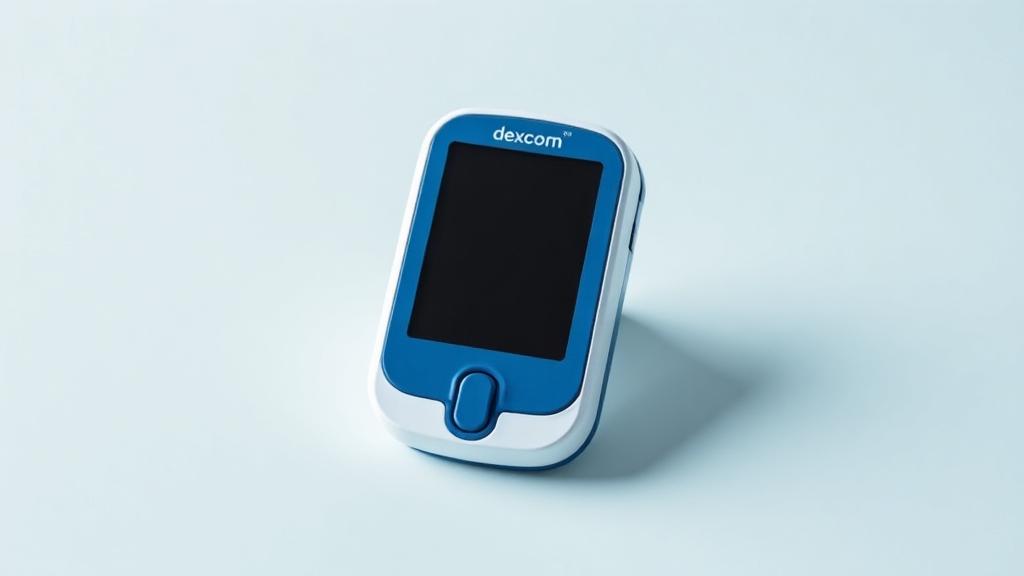
The best Dexcom for most people is the Dexcom G7 15 Day system because it offers the longest sensor life (up to 15.5 days) and best-in-class accuracy, all without fingerstick calibrations. Dexcom makes continuous glucose monitors that send real-time glucose readings to your phone or a receiver – no routine fingerpricks required. The G7 15 Day lasts up to 15.5 days per sensor, the longest of any Dexcom system. A study found about 74% of sensors lasted the full 15 days. Dexcom claims its G7 systems have best-in-class accuracy (data on file, 2025). Always confirm with a blood glucose meter if symptoms don't match the reading. There's also an over-the-counter option called Stelo for people 18+ not on insulin – it doesn't need a prescription.
A Dexcom blood sugar monitor is a continuous glucose monitoring system that uses a small sensor placed under your skin (usually on your abdomen or arm) to measure glucose levels in the fluid between your cells. A transmitter sends that data wirelessly to a compatible smart device (iPhone or Android) or a dedicated receiver. The system shows your current glucose number, a trend arrow, and alerts you if you're going too high or too low. Unlike a traditional fingerstick meter, a CGM gives you a graph of your glucose over time – so you can see patterns. Dexcom's official line is that their CGM simplifies diabetes management using a small device with accurate real-time readings. According to the company, the G7 15 Day is designed for all types of diabetes – type 1, type 2, and even gestational – and is indicated for people age 2 and older.
Dexcom currently sells two main CGM lines: the G6 and the G7. The G7 is newer and comes in two flavors – the standard G7 (10-day wear) and the G7 15 Day (up to 15.5 days). The G6 is an earlier model that still works well and some people stick with it for cost or insurance reasons. Sensor life is a big difference. G6 is 10 days per sensor. G7 is 10 days per sensor. G7 15 Day is up to 15.5 days. That's a huge jump. Dexcom says a study found about 74% of sensors lasted the full 15 days, meaning a quarter might fail early. Accuracy is where Dexcom brags: they claim the G7 systems have the most accurate CGM system and best-in-class accuracy. That's a strong claim. In practice, my experience with the G7 has been solid – readings usually within 10-15 mg/dL of a fingerstick. But I always double-check if I feel low and the sensor says I'm fine. Warm-up time is better on the G7: 30 minutes vs. 2 hours for the G6. That alone is a reason to pick the G7 if you're starting fresh. The G7 sensor and transmitter are all-in-one – a single disc you press onto your skin. The G6 has a separate sensor and transmitter that snaps in. The G7 is smaller, which means it snags less on clothing. Both work with iOS and Android phones, plus Dexcom has a dedicated receiver you can buy separately. The G7 receiver is smaller and has a touch screen. The G6 receiver is also available but it's the older model.
Dexcom also sells Stelo, a glucose biosensor that doesn't need a prescription. It's meant for people 18+ who are not on insulin – think prediabetes or just wanting to track glucose from diet and exercise. It's not a full CGM for diabetes management (you can't use it to dose insulin), but it gives you personal insights on your phone. No fingersticks. That's a game-changer for the general health crowd. I've tested Stelo on a few friends who aren't diabetic. They found it eye-opening to see how their blood sugar spikes after a bagel or comes down after a walk. But for actual diabetes treatment, stick with the G-series. If you're managing type 2 diabetes and also focusing on weight, you might find our guide on /type-2-diabetes-and-weight-loss helpful.
The user guides are available on Dexcom's site. Here's the basic routine. Choose a site: abdomen or upper arm work best. Rotate to avoid scarring. Apply the sensor: clean the skin, use the applicator to press the sensor in. It's a spring-loaded device – quick and not painful. Pair with your device: download the Dexcom G7 app (or use the receiver). The app will scan the sensor code or detect it automatically. Wait 30 minutes: the sensor warms up, then you'll see your first reading. Replace after 10 days (G7) or 15 days (G7 15 Day): the app reminds you. One thing I like: the G7 app shows a graph with your glucose trends, plus arrows telling you if you're rising or falling fast. You can set alarms for high and low thresholds. And you can share your data with family or your doctor through the Dexcom Follow app or the Clarity software.
Dexcom claims its G7 systems are the most accurate CGM on the market. According to their 2025 data, that's what they're saying. In real-world use, I've found the G7 to be very reliable, but no CGM is perfect. The company itself warns: if your glucose alerts and readings from Dexcom CGM do not match symptoms or expectations, use a blood glucose meter to make diabetes treatment decisions. That's printed on their site and in the user guides. So keep a fingerstick meter handy. Also, the G7 15 Day might not last the full 15 days for everyone. Dexcom's own study showed about 26% of sensors failed before day 15. So don't be surprised if you have to change it early occasionally.
If you want the longest wear time and latest tech, get the Dexcom G7 15 Day. It's the best for reducing waste and fewer changes. If you're on a budget or your insurance only covers the G6, the Dexcom G6 is still a solid system. It's well-proven and the accuracy is excellent. If you don't have diabetes but want to track glucose for general health, look into Stelo. No prescription needed, no fingersticks. Always have a backup fingerstick meter. Dexcom tells you this, and I agree – trust but verify. Download the user guides from Dexcom's site before your first use. The PDFs are thorough.
Can Dexcom be used without a smartphone? Yes, Dexcom sells a standalone receiver that displays your glucose numbers. Both the G6 and G7 have optional receivers you can buy. How accurate is Dexcom compared to fingersticks? Dexcom says its G7 systems have best-in-class accuracy (data on file, 2025). In practice, most users find readings within 10-15% of a fingerstick. You should still confirm with a meter if you feel symptoms don't match. Does Dexcom work with insulin pumps? Yes, Dexcom CGMs integrate with many insulin pumps, including the Tandem t:slim X2 and Omnipod 5, for automated insulin delivery. The G6 and G7 are compatible. How often do you have to change the sensor? The standard Dexcom G7 lasts 10 days. The G7 15 Day lasts up to 15.5 days (but about 26% of sensors may fail before then). The G6 lasts 10 days. Is Dexcom covered by insurance? Most private insurance plans in the US cover Dexcom CGMs for people with diabetes who meet criteria. Medicare covers them as well. Check with your provider. Can you shower or swim with Dexcom? Yes, the Dexcom G7 sensor is waterproof up to 8 feet for 24 hours. The G6 is also water-resistant. You can shower, swim, and exercise normally. For those managing insulin resistance alongside weight goals, our guide on /losing-weight-with-insulin-resistance offers practical strategies. And if you're looking to improve overall health through diet and activity, the /how-to-lose-weight resource provides a solid starting point.